Building and Selling the California Dream (Part 3 of 3)
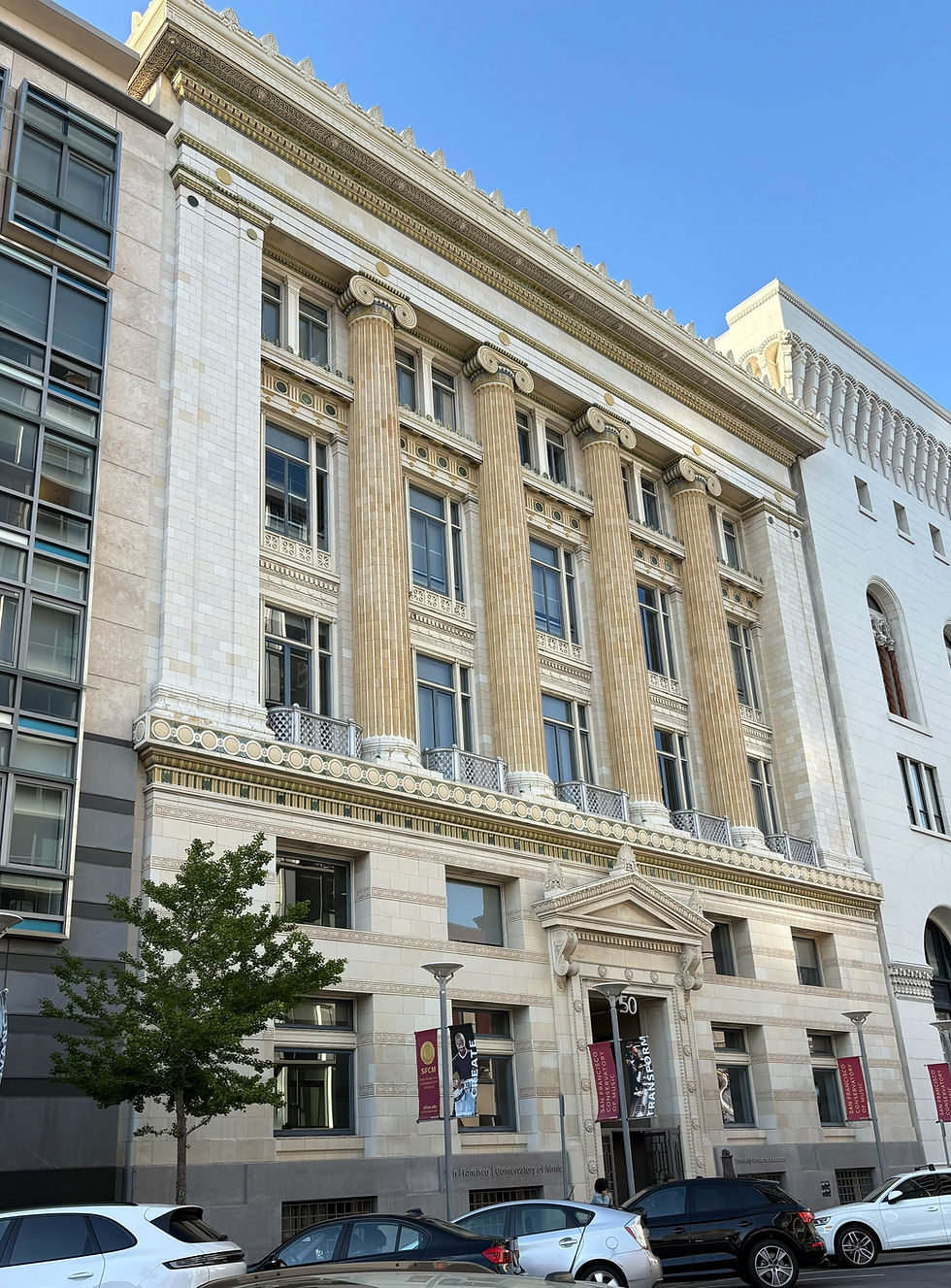
California's interest in Beaux-Arts architecture was not solely practical. Architecture also became a way for the state and its cities to communicate their growing importance. California was geographically distant from the established cultural centers of the East Coast and was still a relatively young American state. Monumental Classical architecture allowed California's leaders and wealthy citizens to associate the state with the long and storied architectural traditions of Europe. Large, symmetrical buildings with columns, domes, monumental entrances, and carefully planned surroundings could communicate wealth, permanence, civic pride, and cultural sophistication.
This desire to use architecture to create cultural prestige became particularly visible in San Francisco. The 1906 earthquake and fire destroyed much of the city, creating an opportunity for rebuilding and redefining San Francisco's architectural identity. Only a few years later, the city hosted the Panama-Pacific International Exposition in 1915. The exposition celebrated the completion of the Panama Canal and demonstrated San Francisco's recovery and growing importance. The fair covered hundreds of acres along the waterfront and used a coordinated Beaux-Arts and Classical architectural language for its major buildings. The Palace of Fine Arts, designed by Bernard Maybeck, is the most famous surviving structure from the exposition and remains one of California's best-known examples of the era's Classical architectural tradition.
The Beaux-Arts influence in California therefore extended beyond the buildings themselves. It influenced the way architects thought about urban planning, civic spaces, universities, and public architecture. The movement encouraged architects to organize buildings around axes, plazas, gardens, and monumental approaches. This system was central to the broader City Beautiful movement, which sought to use architecture and urban planning to create more orderly, beautiful, and impressive American cities. The 1915 exposition was itself an example of this idea, creating an entire temporary city organized through Classical architectural principles.
The influence of Beaux-Arts architecture eventually declined as Art Deco and Modernism became increasingly popular in the 1920s and 1930s. Modernist architects rejected much of the historical ornamentation and Classical vocabulary associated with Beaux-Arts architecture. However, the movement's influence did not disappear. Its greatest legacy may actually be found in architectural education and planning rather than in the continued construction of Classical buildings. The studio-based education, design competitions, emphasis on architectural composition, and attention to the relationship between individual buildings and larger civic spaces all continued to heavily influence architectural practice in the United States.
The significant presence of Beaux-Arts architects in California can be explained by the intersection of education, opportunity, and ambition. American architects traveled to the École des Beaux-Arts because it offered an internationally respected and rigorous architectural education. Many of these architects returned to the United States and applied what they had learned to the rapidly developing American cities. California was particularly receptive because its growing population and economy created an enormous demand for architecture, while its civic and cultural leaders wanted buildings that demonstrated the state's growing importance. Architects such as John Galen Howard, Julia Morgan, Frederick Law Olmstead, Arthur Brown Jr., and Bernard Maybeck helped transform these ambitions into a distinctive California architectural tradition. In this way, Beaux-Arts architecture became more than a French style imported into California; it became a tool through which California expressed its wealth, ambition, civic identity, and emergence as an important cultural center of the United States.